
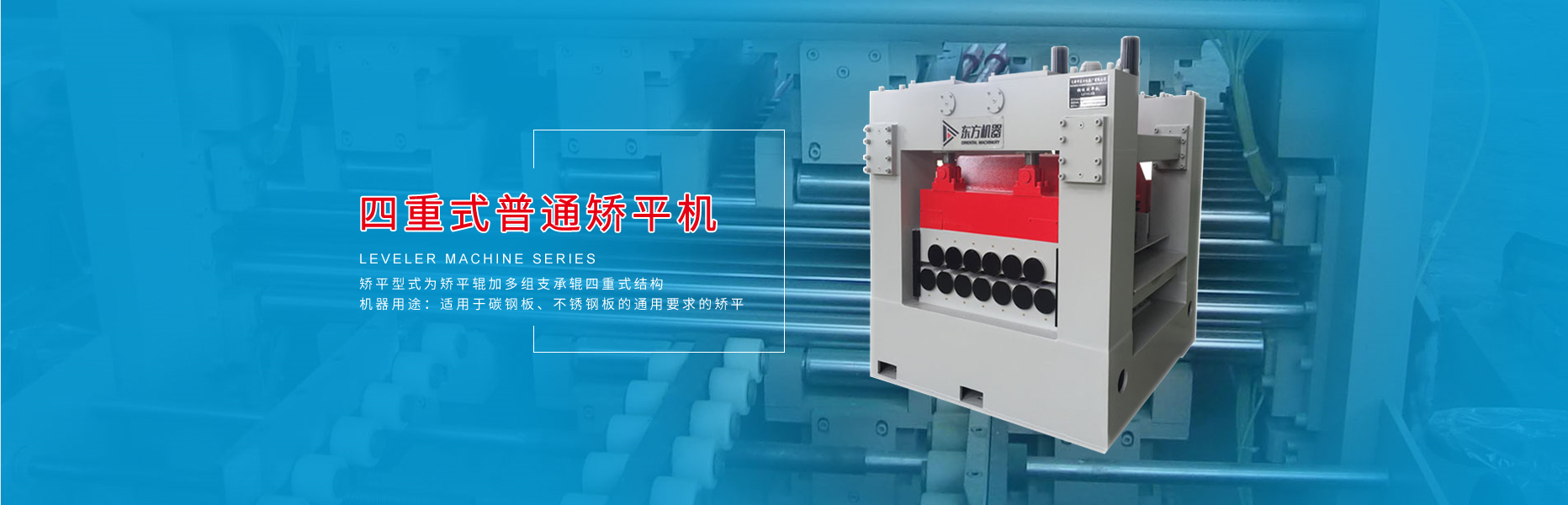
- Leveling Machine
- 4-high leveler machine
- 6-high precise leveler machine
- Leveler machine for special...
- Coil Straightening Machine
- Automatic high speed cut...
- 6-high Automatic cut to...
- Automatic tracking shear...
- Automatic rotary shear...
- Tension leveling line
- Automatic high speed cut...
- Thick Plate Decoiling...
- Automatic Slitting Machine...
- Slitting Line
- Slitting and cutting to length...
- Main parts
Leveler Machine Series
Production Line Series
Cutting Machine
Intelligent container...
Cylinders of shear...
- Wuxi Oriental Machinery Factory Co., LTD.
- Add:No. 50, Hongxiang Road, Hongshan Industrial Park, Wuxi City, Jiangsu Province
- Tel:86-510-88703103
- Fox:86-510-88213609-8008
- Jianwei.Tang 86-139-1533-8317
- Fan.Gao 86-159-6182-5555
| Plate Selection for Leveling Machines |
| Update Time:2015/7/17 14:59:41 Clicks:8943 |
The use of leveling machines also requires careful selection of plate materials. As we know, leveling machines can handle most standard plates without issue. Only in special cases are certain plates difficult to process, requiring other mechanical equipment. Here, the editorial team at Dongfang Machinery will introduce the types of plate materials that can be processed.
On the feed side of the leveling machine, two sets of worm gear mechanisms are rigidly connected as one group, and on the discharge side, two sets are rigidly connected as another group. Motors separately drive the two groups of worm gear sets to raise or lower the two sets of pull rods, thereby causing the working surface of the upper leveling rolls to move up, down, or tilt relative to the working surface of the lower leveling rolls. This allows adjustment of the leveling gap as well as the entry and exit inclination angles. The adjustment changes are fed back by encoders, and a digital display is provided on the operator console. All leveling rolls and feed rolls are driven. The transmission sequence is as follows: the AC motor drives the reducer, and through a distribution gearbox, power is transmitted to the leveling rolls and feed rolls via universal joints. The distribution gearbox features a double-layer power transmission design with high-strength intermediate gears, a rational gear layout, and a long service life. The leveling rolls and support roll bearings are rolling bearings. To ensure reliable lubrication, the machine adopts a centralized pressure lubrication system. The leveling roll bearings are imported bearings with high support precision, meeting the requirements for high-precision plate leveling.
For more information about leveling machines, please visit http://www.dfjq.com |
Total Pages:1 Page 1  |
| Previous Article:Optimal Adjustment Settings for Plate Leveling Machines Next Article: |