- Leveling Machine
- 4-high leveler machine
- 6-high precise leveler machine
- Leveler machine for special...
- Coil Straightening Machine
- Automatic high speed cut...
- 6-high Automatic cut to...
- Automatic tracking shear...
- Automatic rotary shear...
- Tension leveling line
- Automatic high speed cut...
- Thick Plate Decoiling...
- Automatic Slitting Machine...
- Slitting Line
- Slitting and cutting to length...
- Main parts
Leveler Machine Series
Production Line Series
Cutting Machine
Intelligent container...
Cylinders of shear...
- Wuxi Oriental Machinery Factory Co., LTD.
- Add:No. 50, Hongxiang Road, Hongshan Industrial Park, Wuxi City, Jiangsu Province
- Tel:86-510-88703103
- Fox:86-510-88213609-8008
- Jianwei.Tang 86-139-1533-8317
- Fan.Gao 86-159-6182-5555
| Stress Relief Through Leveling Technology |
| Update Time:2015/7/24 8:58:00 Clicks:11824 |
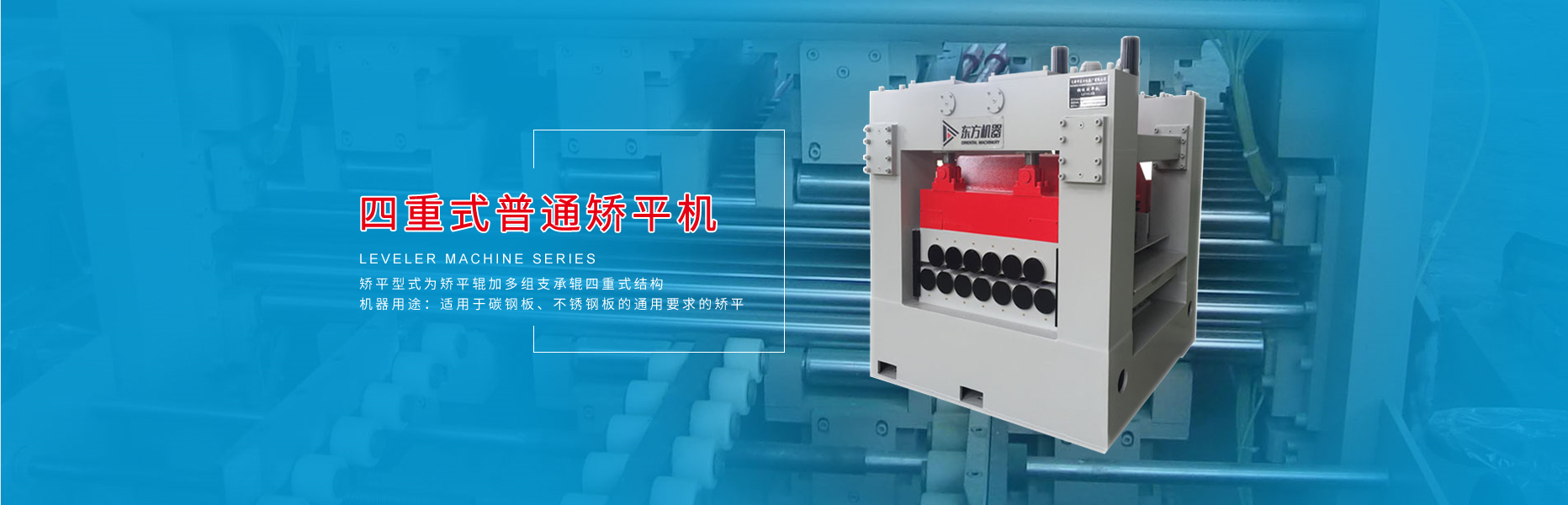
In order to eliminate stress within the material, sheets must be leveled. The fundamental principle of roller leveling is to selectively elongate different sections of the material. Below the material's yield point, the shorter "fibers" of the sheet are proportionally stretched to achieve a consistent "fiber" length. This is accomplished by passing the material through the leveling machine where it undergoes repeated cyclic up-and-down bending at a small radius of curvature, thereby elongating the shorter material "fibers." As the sheet moves toward the exit of the leveling machine, the amplitude of the up-and-down bending gradually decreases, eliminating the material deformation caused by the intense bending at the entry of the machine. When all the "fibers" in the material are nearly the same length, the sheet becomes flat — or, in other words, "leveled." To achieve satisfactory leveling results, it is essential to select the appropriate leveling machine based on the specific processing task at hand. In most cases, the sheets to be leveled are processed from coil stock, making the leveling machine a critical component in the entire material handling production line. The simplest type of machine is the Flattener, which has fewer leveling rolls with large diameters and no backup rolls. However, to achieve higher flatness, small-diameter leveling rolls, smaller roll spacing, and proper support of the leveling rolls by backup rolls are indispensable. Therefore, simple flatteners cannot produce sufficient deformation in the material to achieve good flatness, and as a result, they are not widely used.
Currently, three main types of leveling machines are widely used in overseas markets: Standard Leveling Machines, Precision Leveling Machines, and High-Performance Leveling Machines. All three types feature structurally well-supported leveling rolls, smaller roll spacing, and adjustable work tables in their design. The drive system for the leveling rolls is crucial to the operational efficiency of the leveling machine — all leveling rolls must be driven.
For more information about leveling machines, please visit http://www.dfjq.com
|
Total Pages:1 Page 1  |
| Previous Article:Operating Procedures for Leveling Machines Next Article:The Function of Sheet Metal Leveling Machines |